Augusta's Elk Came Down Early This Fall, and the Season Changes Again After Dec. 1
November 12, 2026
November 12, 2026
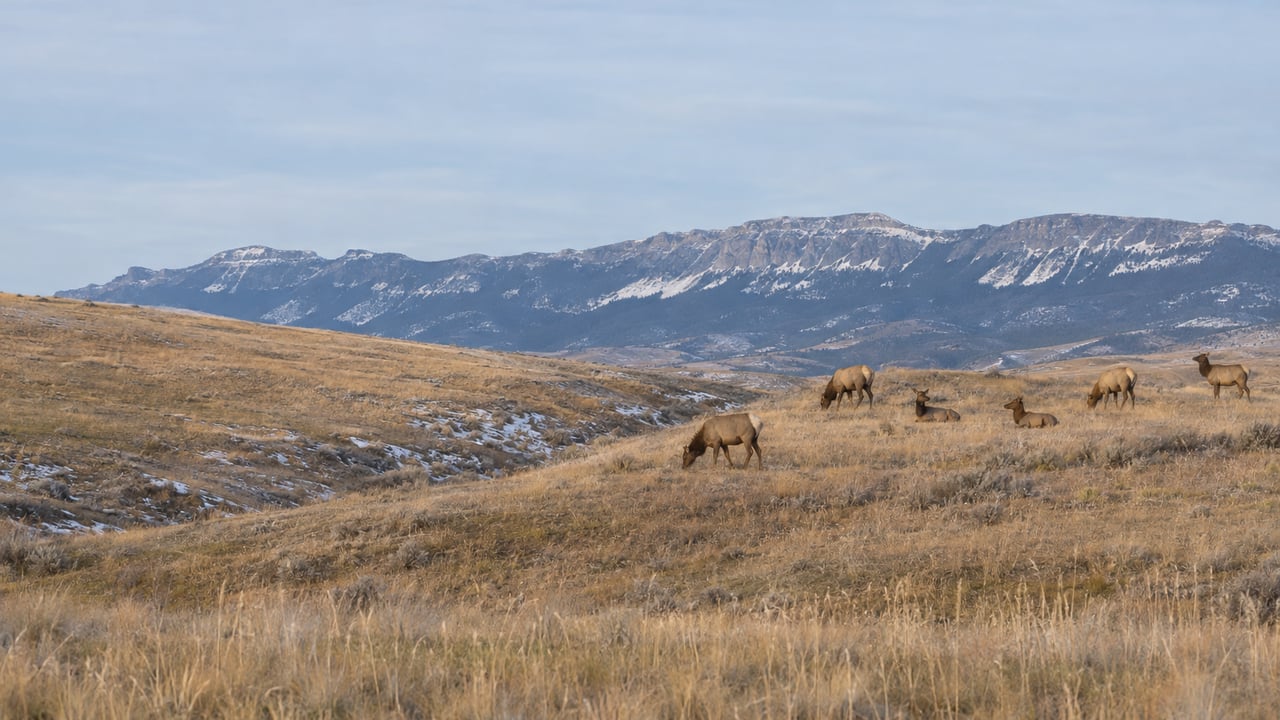
When the last rifle hunter checks out on Main Street, where do the Sun River elk go? Most of them go nowhere, and that has been the plan since 1948. The herd's winter range sits west of Augusta and was bought to hold these animals through the cold months. This year part of the herd arrived early. That means late November in Augusta brings an unusually close look at the handoff. Elk move from the hunting season into the quiet months, and for the rest of the winter the place to see them is the shoulder of a county road.
Montana's general deer and elk season opened Oct. 24 and runs through Sunday, Nov. 29. Weather got to the Front first. FWP Region 4 credited heavier snowfall earlier in October and a fresh round of snow and cold the day before the opener with pushing animals out of the backcountry and down to lower ground. That happened "especially" with the Sun River herd, a portion of which "has already arrived on the Sun River Wildlife Management Area," according to the opening-weekend report published by Montana Outdoor on Oct. 28, 2026.
The Augusta check station on Main Street recorded it. Here is how the first two reporting periods compare with the long-run averages FWP uses:
| Augusta check station, 2026 | Count | Against the baseline |
|---|---|---|
| Hunters, opening weekend | 235 | 10% above the 10-year average |
| Success rate, opening weekend | more than 22% | 10-year average is 18% |
| Elk checked, opening weekend | 22 | 83% above the 10-year average |
| Hunters, through Nov. 1 | 630 | 9% above average |
| Success rate, through Nov. 1 | 26% | 10-year average is 19% |
| Elk checked, through Nov. 1 | 71 | more than 30% above the long-term average |
The elk number stands out. Deer harvest through Nov. 1 ran about 12% above average, with 41 mule deer and 55 white-tailed deer checked. Elk ran much further above the line because the early snow brought them down where hunters could reach them, earlier than usual.
The early surge didn't last. In its Nov. 3 update, also carried by Montana Outdoor, FWP said moderating weather had reduced elk movement after October's first push. Hunting success in hunting district 442 had "declined somewhat." As of that update, the HD 442 quota was still open to antlerless harvest. FWP noted that if the quota fills, antlerless elk harvest closes there, while the brow-tined bull season stays open through Thanksgiving weekend.
So part of the herd is already settled on winter range, and the rest is waiting on the next real cold snap.
The general season is now in its closing weeks, and Thanksgiving falls on Nov. 26, the last week before the close. The check station on Main Street is the only biological check station in FWP Region 4. It runs seven days a week, from 5:30 a.m. to 9:30 p.m. on weekdays and until 10 p.m. on weekends, through the Nov. 29 close. FWP reminds hunters that they must stop at any check station they pass while hunting, whether or not they've harvested anything.
Bears are also still out. In the same Nov. 3 update, FWP said hunters were still reporting grizzly bears and grizzly sign despite the snow and cold. The agency urged caution around carcasses, camp food storage and meat packing. That matters on a late-season walk along the foothills too.
The Sun River Wildlife Management Area was established in 1948, and FWP describes its primary purpose plainly as winter range for the Sun River elk herd. Up to 95% of the herd winters there. FWP's own history of the purchase, in the Montana Outdoors "Best 100" feature, says local hunters helped make it happen. It also says the land relieved local ranchers whose property elk grazed whenever snow pushed them down from the mountains. The same feature put the Sun River WMA at number one on the list.
The herd count shows the system working. FWP's Region 4 elk document estimated the herd at 2,304 elk from winter and early-spring 2025 observations: 1,469 cows, 367 calves and 355 brow-tined bulls observed. That falls inside the objective of 2,500 elk, plus or minus 10%. Nearly all of them are typically counted on the WMA itself. That makes the WMA the place where FWP counts the herd as well as where the herd spends the winter.
That explains the closure. The WMA's FWP page lists the area as open from noon May 15 through Dec. 1. The 2026 FWP hunting regulations list the Sun River closure as "Dec 02 - May 15." Under the statewide rule, WMAs with game-animal winter range close the day after the general season or on Dec. 1, whichever is later. The regulations point visitors to FWP Region 4 Headquarters in Great Falls, 406-454-5840, for the area map and rules.
The habitat behind the closure is still being worked on. FWP's 2025 forestry report to the Legislature describes conifer removal and prescribed burning on the WMA with the Helena-Lewis and Clark National Forest. That work included 278 acres burned in the winter of 2023–24 to improve big-game winter range, under an FWP and Forest Service agreement in effect through Feb. 1, 2027. The grass this year's early arrivals are grazing is ground that was cleared and burned for them.
The herd stays in view all winter from a county road west of town. FWP's directions run like this:
During the closure, the same FWP feature says large concentrations of elk can still be seen through the winter from Augusta Willow Creek Road. The road lets you watch the herd without crossing the boundary that protects it.
The winter ends with a crowd. On May 15, 2026, KRTV reported hundreds of people arriving on foot, on horseback and in trucks when the WMA reopened for the annual shed hunt. Between Dec. 2 and that May morning, the antlers stay where the elk drop them.
The season closes on a Sunday and the WMA closes that Wednesday. The following weekend, town life moves indoors, according to the Augusta Chamber's event calendar:
The derby is out on Willow Creek, and the elk spend the same months on the winter range west of town.
If you're watching how the Front's seasons shape life around Augusta, from the elk on the winter range to the weekends people plan around them, the team at Live In Montana Real Estate follows it all year. Connect with a Montana expert who knows the country west of Main Street.
Stay up to date on the latest real estate trends.

Live In Montana Real Estate delivers deep local knowledge and full-service support—residential, land, and commercial. Let them guide you through Montana’s unique market with integrity, expertise, and personalized care for every property need.