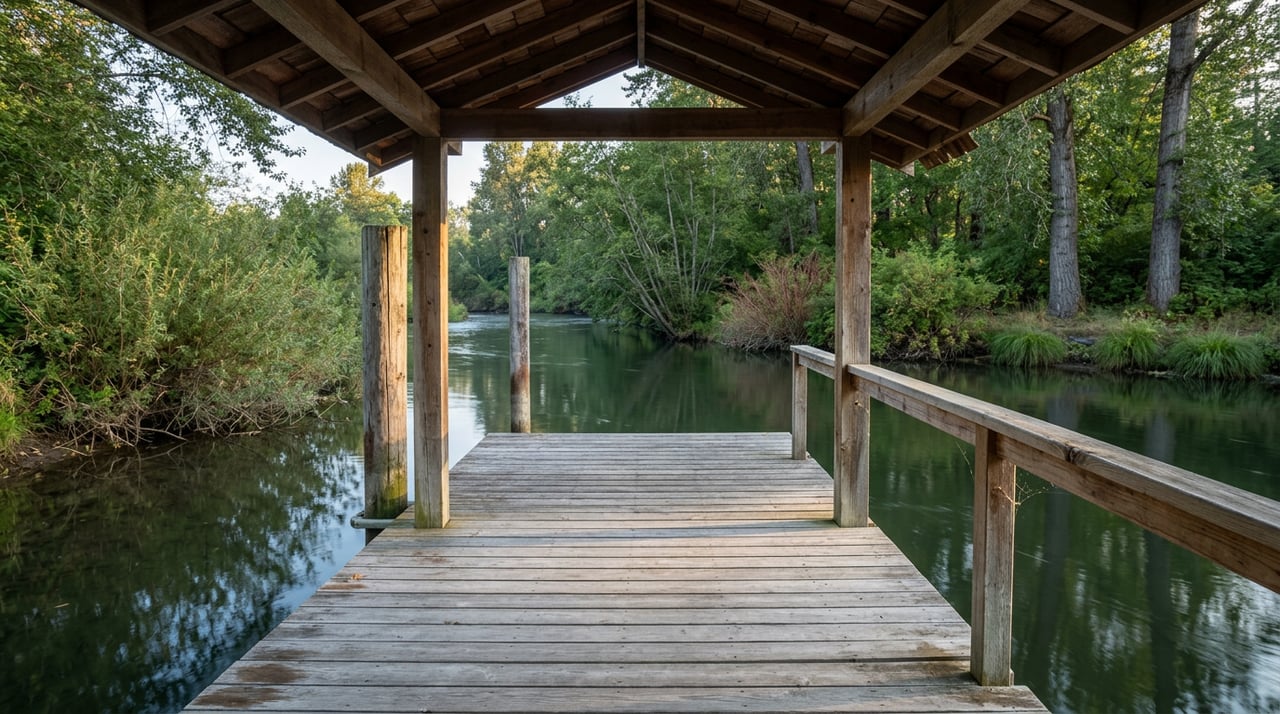
The Wolf Creek Population Sign Doesn't Match What Summer Actually Looks Like
August 20, 2026
August 20, 2026
By 6:45 on a July morning, there are already four trucks with drift boat trailers backed up along the gravel apron at the Wolf Creek Bridge access, engines running, headlamps still on because the canyon holds shadow longer than the open bench above it. Inside Wolf Creek Angler down the road, owner Jason Orzechowski is running through the day's shuttle list, and it is, as his own shop reports keep admitting, impossible to predict. Some mornings the board fills with a handful of names. Other mornings every slot is gone before the coffee's done. Lodging does the same thing, a full house one night and what the shop itself calls a ghost town the next.
None of that shows up on the sign at the edge of town, which if it matched the last federal count would tell you Wolf Creek has 22 residents. That number is real. It is also almost useless for understanding what a Tuesday in July looks like here, and figuring out why is the actual story.
The 22-person figure comes from the 2020 census tally for the Wolf Creek census-designated place, and current population trackers still peg the town at that same count. It's a tight boundary drawn around a tight cluster of buildings. The U.S. Postal Service, working from a wider service area that includes the ranches, cabins, and river frontage strung out along the corridor, lists something closer to 635 people who actually get their mail routed through the Wolf Creek office. Same town, same zip code, two numbers nearly thirty times apart, because one counts a dot on a map and the other counts everyone who has to drive past that dot to get their packages.
That gap matters more once you add the river. Fly shops that track the Missouri corridor describe Craig and Wolf Creek as towns that effectively double in population during the peak stretch of the pale morning dun hatch in late June, when flows drop enough that the fishing turns predictable and word gets out fast. Doubling 22 people is a rounding error. Doubling 635 is a real seasonal surge, and it's the second number that actually explains the truck count at the bridge, the reservation wait at the Hub Saloon, and the reason Wolf Creek Angler's own shuttle board swings from empty to maxed out inside the same week.
The other number worth sitting with this summer is the flow itself. A live check on the gauge below Holter Dam this year showed the river holding around 3,130 cfs on a stable trend. Set that against the eighty-year same-date record for that gauge, covering readings from 1946 through 2025, where the historical average for this point in the calendar runs closer to 6,800 cfs and even the low end of the range, the bottom quarter of all those years, still sits near 3,830 cfs. This year's number is under that lower bar. Water temperature checked in around 59 degrees, comfortably cool for trout and nowhere near a heat-related fishing restriction, but the flow itself is thin for the calendar date by any historical measure.
That's not a crisis. The Missouri below Holter is a tailwater fed by a chain of three reservoirs upstream, which is exactly why it holds a stable temperature and a long season instead of behaving like a freestone river that blows out with every storm. But a lower-than-typical flow changes the daily calculus for anyone actually working this water. It means more of the river's holding water sits in the flats and slicks rather than the deep runs, which is why guides have been pointing clients toward wading the shallower shelves early and saving the technical dry fly water below Spite Hill for the evening caddis push. It means boat traffic bunches up at the same handful of access points instead of spreading the length of the corridor, because low water narrows where a drift boat can actually put in cleanly.
The named access chain running this stretch hasn't changed, and knowing it by name is still the fastest way to plan around a crowded morning:
Walk-in access connects all of them, which is precisely why a low-flow year pushes foot traffic into these gaps between the formal boat ramps.
There's a quieter shift this year that has less to do with water and more to do with paperwork. As of 2026, every Montana fishing license has to be purchased online through Montana Fish, Wildlife & Parks before you can legally fish, with no more counter sales at the shop the way there used to be. For locals who've fished this water for decades, that's a minor inconvenience solved with a phone. For the wave of out-of-town anglers who show up assuming they can walk into Wolf Creek Angler or the Trout Shop in Craig and buy a license the same way they'd buy leader material, it's turned into the most common holdup of the morning rush. Shop staff now spend a chunk of peak-season mornings walking first-timers through the state's website instead of ringing up flies, which is a small operational shift but a real one if you've stood in that line.
However the season swings, it funnels through the same two operations. Wolf Creek Angler bills itself as the one-stop shop for the stretch, covering shuttles, guided trips, lodging, and what the shop describes as the largest fly selection assembled under one roof in town, with new gear arriving almost daily through the season. Its own reporting this year has been candid about the unevenness of it all, guides fully booked one stretch and standing by with open days the next, which tracks with a lower-than-average flow year pulling anglers toward the days when conditions actually line up rather than spreading demand evenly across the calendar.
Down in Craig, the Trout Shop runs 6 a.m. to 6 p.m. as the corridor's default stop for coffee, breakfast sandwiches, and deli food, while the Hub Saloon inside the same lodge opens nightly from 6 to 9 for dinner, pizza, and a beer at the end of a long day on the water. Reservations there run through OpenTable under a search for Craig, Montana, which has become the practical way locals and regulars beat the wait once the season's in full swing.
Put the population gap next to the flow gap and the same pattern shows up twice. The official count of Wolf Creek understates what the town actually holds once you include everyone the post office serves along the river. The official flow reading this year understates what a typical summer looks like on this stretch, sitting below even the historical low end for the date. Neither number is wrong. Both are just measuring a narrower slice of reality than the one you're standing in if you live along this corridor, work the counter at one of its two shops, or trailer a boat down to the bridge before the light comes up.
If you already know this stretch of the river, none of that will surprise you. If you're weighing whether this corner of Lewis and Clark County fits the way you want to spend your time on the water, that gap between the official numbers and the lived-in version of the place is worth understanding before you make any decisions about property here. Live In Montana Real Estate works this exact stretch of the state and can walk you through what river access, seasonal traffic, and land along this corridor actually look like beyond what the public numbers show.
This article is general information, not legal, tax or financial advice. Consult a qualified professional about your situation.
Stay up to date on the latest real estate trends.


Live In Montana Real Estate delivers deep local knowledge and full-service support—residential, land, and commercial. Let them guide you through Montana’s unique market with integrity, expertise, and personalized care for every property need.